Church Street
Church Street was known as St. Marygate in the Middle Ages. Today St. Marygate refers only to the lane and steps leading up to the Priory Church. Church Street was used as an open market on Lancaster fair days (3 April, 1 May, 5 July and 10 October). There are several fine Georgian buildings along Church Street.
The west end of Church Street from St. Marygate.

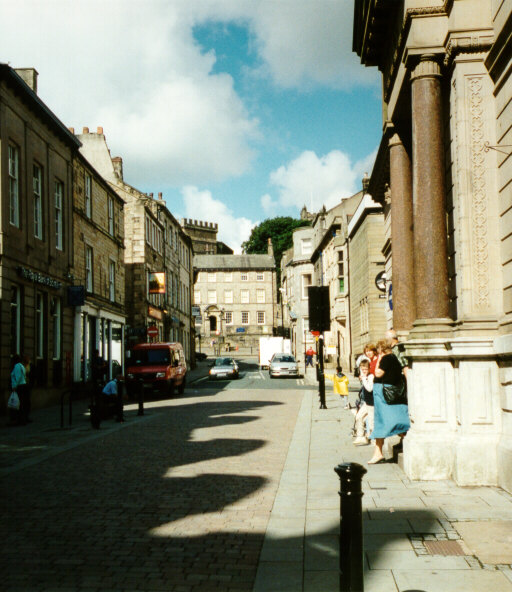
Looking west up Church Street towards the Judges Lodgings and the Castle. The National Westminster Bank on the right was formerly the Lancaster Banking Company. This was established in 1826 after two local banks had collapsed in the early 1820s. It was one of the first joint-stock banks in the UK. The present building dates from 1870 and has a fine banking hall.
The Roman Civilian Settlement 
Roman Church Street had long, rectangular buildings with their gable ends facing on to the street with possibly a shop on the street frontage. You can read more about some of the archaeological investigations on Church Street in a Contrebis article by Ian Miller.
76 Church Street
The front of 76 Church Street dates from the 1730s but the rest of the building may date from 1637. It was owned by the Marton family in the 18th century and Bonnie Prince Charlie stayed here in October 1745 on his way south and again in December 1745 on his way back north. It became home of the Conservative Club in 1883 until 2000 when the building became offices.
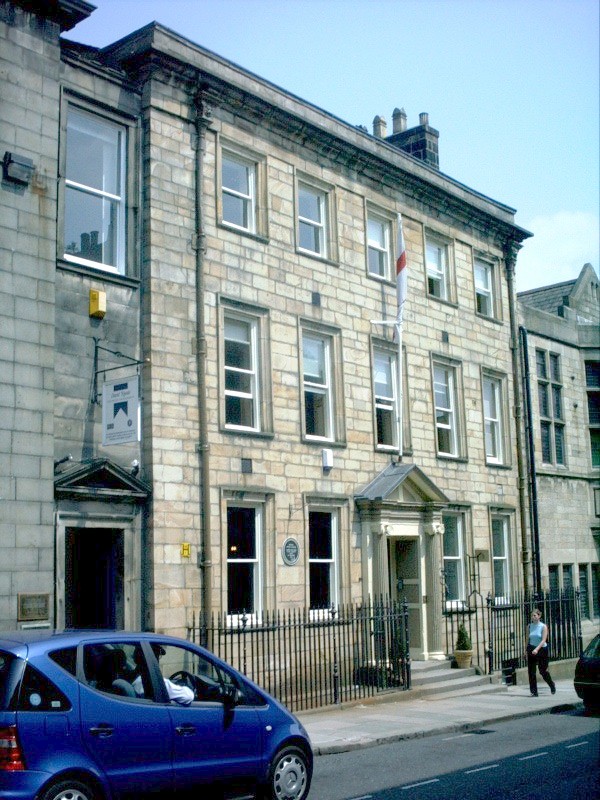
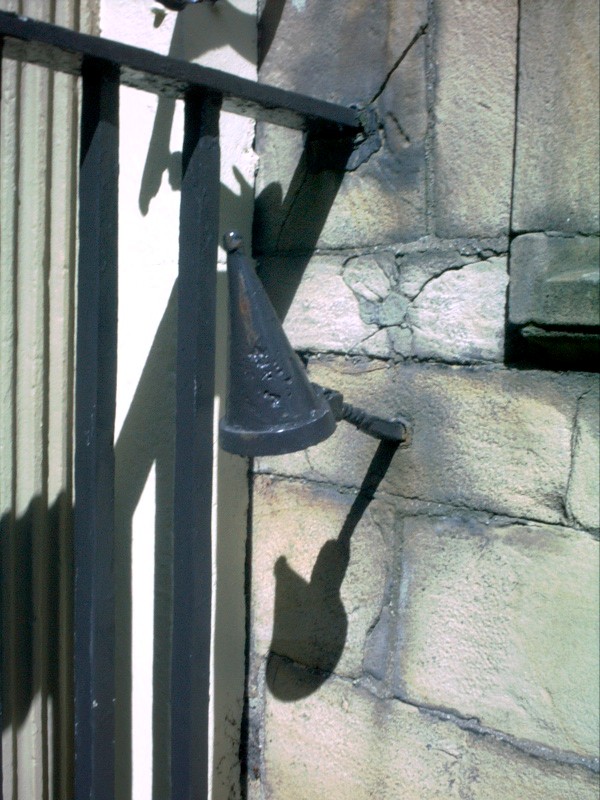
Behind the railings, attached to the wall of 76 Church Street, is a rare link extinguisher. Before the days of street lighting, torches or links were carried in front of carriages travelling at night.
At the top of Church Street, cross China Street at the pedestrian crossing, the Judges Lodgings ahead of you.
Judges Lodgings
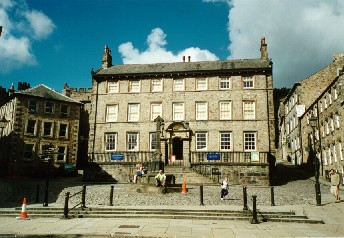
The Judges Lodgings is the oldest surviving home in Lancaster. It was built between 1610 and 1639. The roof contains timbers from an even earlier, medieval building. It was the home of Thomas Covell, the Prison Governor. In 1826 it became the lodgings for the judges presiding over the Assizes (courts) in Lancaster Castle. After the Assizes moved to Preston in 1975 it became a Museum, housing a wonderful collection of Gillow furniture and a Museum of Childhood. The east gate of the Roman fort was situated approximately in the gap between the Judges Lodging and the buildings of St. Marygate on the right of this photograph. Check the Museum's opening times.
Covell Cross
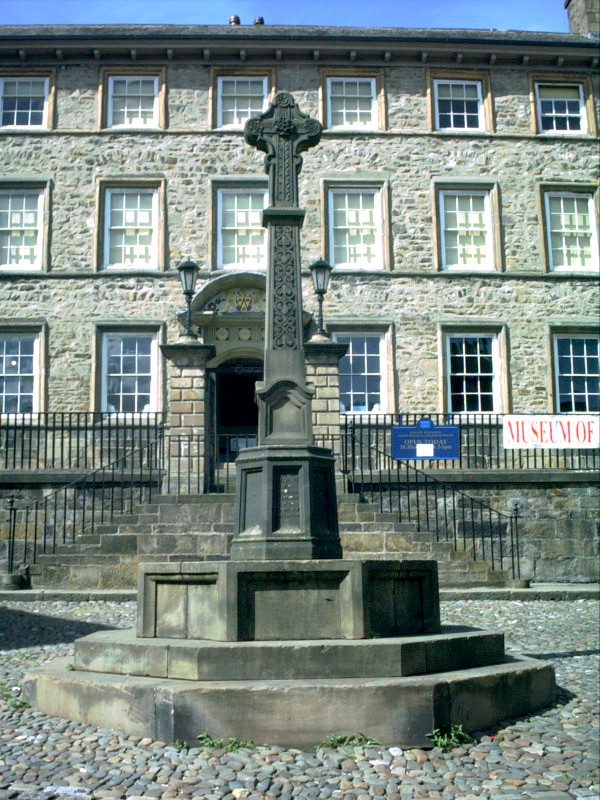
The Cross in front of the Judges Lodgings marks the site of an ancient cross. It was designed by Austin and Paley and erected in 1902. It is named after Thomas Covell, a former owner of Judges Lodgings and Keeper of the Castle. He, along with the Mayor of Lancaster and another Justice of the Peace, questioned the Pendle Witches during their imprisonment and trial in the Castle in 1612. Covell died in 1639 and a plaque commemorating Covell can be seen in the Bell Tower of the Priory.
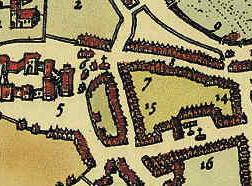
The Cross is shown on Speed's map of 1610. The building on the site of the Judges Lodgings (no. 6) is referred to as Old Hall.
Turn left in front of the Judges Lodgings and proceed up the narrow, cobbled Castle Hill.


 Next
Next