Lancaster Station
Originally known as Lancaster Castle station, Lancaster Station opened in 1846 as the southern station of the Lancaster and Carlisle Railway. The original route was to have been to the east of the town, following the Canal and crossing the Lune from Ladies Walk to Skerton. Although work started on this route, an alternative and cheaper route west of the town was used with a station west of the Castle and a bridge across the Lune near Vicarage Fields. The line was officially opened on 21st September 1846 and the first public service ran on 17th December. The L and C was absorbed by the London and North Western Railway in 1879. Castle Station was remodelled in 1902 with additional lines and platforms.

The original buildings are on the west side of the railway line, at the left of the block of buildings shown in the photograph. The mock Elizabethan architecture of the extended section on the right was intended to mirror the battlements of Lancaster Castle above the station and was the head office of the Lancaster and Carlisle Railway Co.
Leave the station by the west exit (off Platform 3), cross the car park, turn right on to Station Road and then left to West Road. Walk 100m down West Road to the entrance on your left to Westfield War Memorial Village.
The Village was opened in 1924 as a purpose-built caring community for veterans of World War 1 who could not rejoin their families because of physical or psychological conditions. The Village was built using charitable funds and local donations, and was designed by Thomas Mawson of Lancaster. The bronze statue by Jenny Delahunt, a local sculptor, of one soldier helping another is very moving.
The Grammar School 
At the top of West Road, turn sharp left down Long Marsh Lane and then right, along to the end of Hillside. Here is the site of the original Free Grammar School.
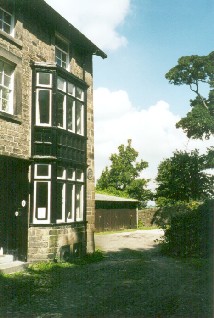
The will of John Gardyner of Ellel made provision for a chantry chapel, an almshouse and a school. The school was founded in 1485 with the intention of providing free tuition in morals and Latin. In 1500 the school's timetable was 6-8am, 10am-12 noon and 2-6pm. Private donations and support from the Borough Corporation allowed the school to survive. It was rebuilt in 1682 and moved to East Road in 1851. Nothing remains of the earlier buildings.
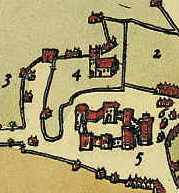
Its position (No. 3) is shown on Speed's map of 1610
Return to West Road and walk on with the Castle on your left.


 Next
Next