St Leonardgate
Walk to the junction of Bulk Road and St Leonardgate. The white building in the photograph - the mid-18th century White Lion pub - closed in 2002. It was formerely the site of a toll bar for goods entering Lancatser from the east. It is now accommodation.
St Leonard's Hospital 

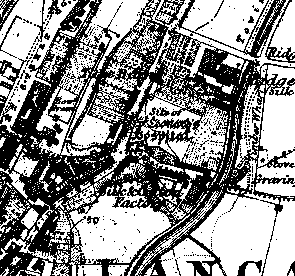
St Leonard's Hospital was situated at the northern end of St Leonardgate. It was a leper hospital in the Middle Ages, founded by John, Earl of Mortain (later to be King John) in 1189-94. It was situated next to a small beck which marked the boundary between the borough of Lancaster and the Manor of Newton in Bulk township. By law, leper hospitals had to be situated outside town boundaries and St. Leonard's was on the Newton side of the beck. The beck was called Jelle Beck in 1684 and today it runs under Factory Hill (the road disappearing behind the White Lion in the photograph). The hospital held only nine inmates. Henry of Grosmont, Duke of Lancaster, gave the hospital to the nunnery of Seton in West Cumbria in 1356 and it fell into decay as leprosy declined.
Part of the chapel survived into the late 19th century. A tombstone and burials were found in 1811. The site of the hospital is marked on this map of 1845.
Turn right and walk along St Leonardgate for 100m towards the city centre. The area to your right was once occupied by the Phoenix Foundry.
Phoenix Foundry

The area around Phoenix Street in 1890 showing the foundry, previously sugar-processing works. Phoenix Foundry was owned briefly by Edmund Sharpe, the architect and entrepreneur. It made railway rolling stock in the 1840s and 1850s as well as castings, steam engines and other engineering products. The site of the foundry became a car showroom in the 1930s and is now a retail park.
Continue down along St Leonardgate and look right, down Phoenix Street, as you pass.

This building in Phoenix Street was once the territorial headquarters in Lancaster for local volunteer militia.
The Grand Theatre
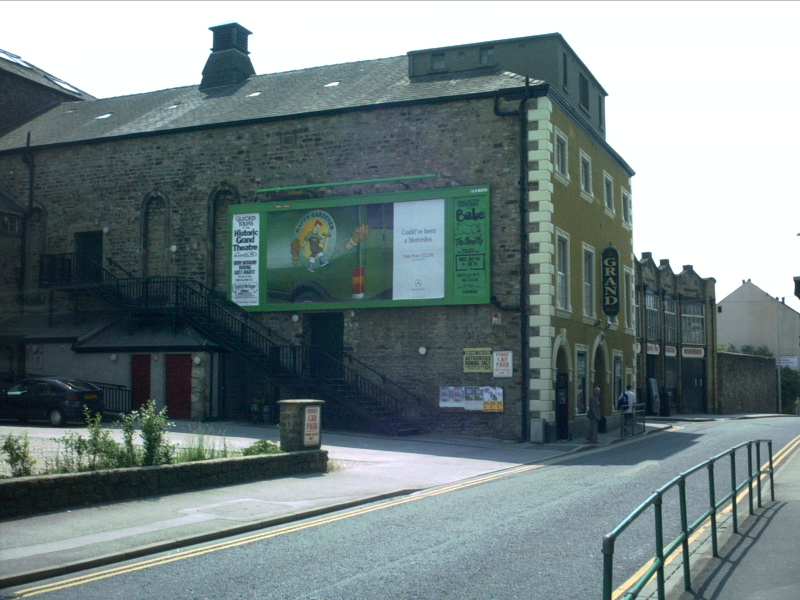
The Grand Theatre was built by public subscription in 1782. The subscription was organised by Joseph Austin and Charles Edward Whitlock who also managed a number of other theatres in the north of England. The first performance took place in June 1782. Sarah Siddons, the sister-in-law of Whitlock and a famous actress of the time, performed on a number of occasions at the theatre, including the role of Lady Macbeth in 1795. Her ghost is said to haunt the theatre. Frank Matcham's 1897 interior of the Grand was destroyed by a fire in 1908, and was redesigned by Albert Winstanley. It still functions as a theatre.
Continue to the end of St Leonardgate.
Georgian buildings at the western end of St Leonardgate. These were built around 1792.

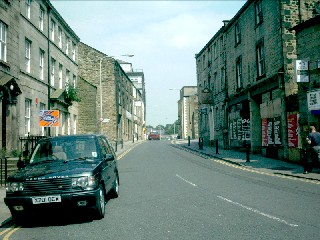
At the end of St Leonardgate, turn left into Stonewell.


 Next
Next