Dalton Square


Two views of the east side of Dalton Square

No. 2 Dalton Square was home of Dr. Buck Ruxton, the Lancaster murderer who killed his wife and servant in 1935. Next door, to the right, is Palatine Hall, previously the County Cinema and before that the Hippodrome variety hall and opera house. Originally it was a Catholic chapel built in 1798.
The Friary 
Dalton Square occupies the site of a Dominican Friary. The Friary church lies beneath Sulyard Street and the cemetery lies between Sulyard Street and Moor Lane.
The Friars first settled in around 1260. The precinct was 12 acres in extent and was bounded to the west by Penny Street and to the north by St. Nicholas Street and Moor Lane. Its southern and eastern boundaries are marked by modern George Street and the canal. The site was sold to Sir Thomas Holcroft at dissolution in 1539 for £126 10s and a house called the Frierage was built, incorporating some of the Friary buildings. Its position is shown on Speed's map of 1610 (no 18).
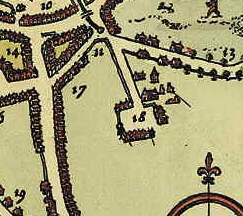
John Dalton obtained an Act to develop the Frierage site in 1784. The original design by Edward Batty was never fully implemented because of an economic decline at the end of the 18th century. Fragments of the precinct wall survived into the 19th century. The square was redesigned in Edwardian times.
Victoria Monument
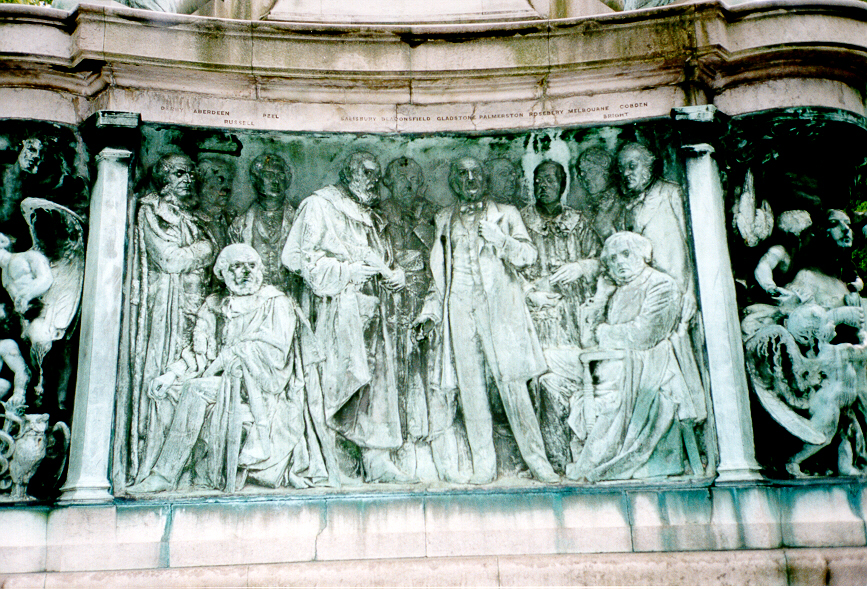
The Victoria Monument was given to the town by Lord Ashton in 1907. It was originally intended for Williamson Park. The sculptor was Herbert Hampton. Queen Victoria and four lions are in bronze. The panels have reliefs of 53 eminent Victorians: five had strong Lancaster connections. Only two, Florence Nighingale and George Eliot (Mary Ann Evans) were women. The corner pieces represent Truth, Wisdom, Justice and Freedom.

The Town Hall

The new Town Hall, built on the site of Georgian merchants' houses, was designed by E W Mountford, who was also the architect for the Old Bailey in London, and was paid for by Lord Ashton. It opened in December 1909, replacing the old Town Hall in Market Square. It originally contained police headquarters and courts as well as council offices. To your right, at the junction of Brock St and Thurnham St was the house of Richard Owen, of the British Museum and Natural History Museum, who invented the term 'dinosaur'.
Enter the gates on the left (east) side of the Town Hall.
The War Memorial
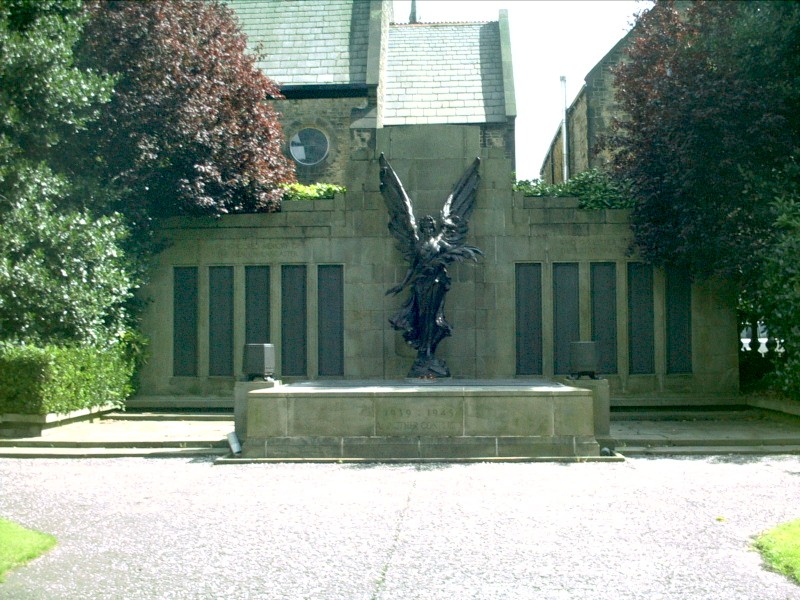
Lancaster's War Memorial stands in a small Garden of Remembrance on the east side of the Town Hall. It was designed by Thomas Mawson and Sons and it commemorates the dead of the two World Wars and other conflicts. The ten bronze panels record the names of 1,010 Lancastrians who fell in the First World War. The panels were dedicated on 3rd December 1924. The plinth in front of the statue carries the names of a further 300 who fell in 1939-45.
Pass through the gates on the south side of the Garden and turn left into George Street.


 Next
Next